
Four Key Considerations for Selecting Concrete Mixing Plant
Apart from production capacity, the core performance indicators of a concrete mixing plant directly determine concrete quality, operational efficiency and environmental compliance. The four aspects below are critical items that must be thoroughly inspected when purchasing a mixing plant.
Main Mixer – The Heart of the Mixing Plant
The mixing main unit is the core component of a concrete mixing plant. Twin-shaft compulsory mixers are the mainstream configuration at present. Their forced mixing mechanical principle guarantees uniform blending of concrete, with slump deviation controlled within 10 mm under standard configuration. It should be noted that different types of concrete impose differentiated requirements on the main mixer. For ordinary civil construction and low-grade plastic concrete, a general-purpose twin-shaft compulsory main mixer is sufficient.
Batching System — Quality Gatekeeper
The precision of concrete mix proportion directly determines project quality. The metering system must meet national accuracy standards: the weighing error of coarse aggregate shall be ±2%, that of fine aggregate ±1%, and the weighing errors of cement, water and admixtures shall be controlled within ±1%. It is recommended to give priority to systems equipped with high-precision sensors and automatic compensation technology. Such systems can correct weighing deviations in real time and guarantee accurate mix proportions for every batch of concrete. An inaccurate metering system will not only impair concrete quality but also lead to material waste. Every extra kilogram of cement used will directly raise costs and bring greater environmental impacts.
Environmental Protection Accessories — Non-Negotiable Standards
Current environmental protection policies impose mandatory requirements on concrete mixing plants. When purchasing, verify whether the equipment is fitted with fully enclosed aggregate bins, pulse dust collectors, sand-stone separators and slurry water recycling systems to meet the green production standards for ready-mixed concrete.
Safety Protection — The Overlooked Red Line
Safety is the fundamental guarantee for the stable operation of a concrete mixing plant. Belt conveyors shall be fitted with protective nets, and safety valves must be installed on the top of cement silos to prevent explosion caused by overpressure. In terms of fire protection, dry powder fire extinguishers should be equipped to comply with safety technical specifications.
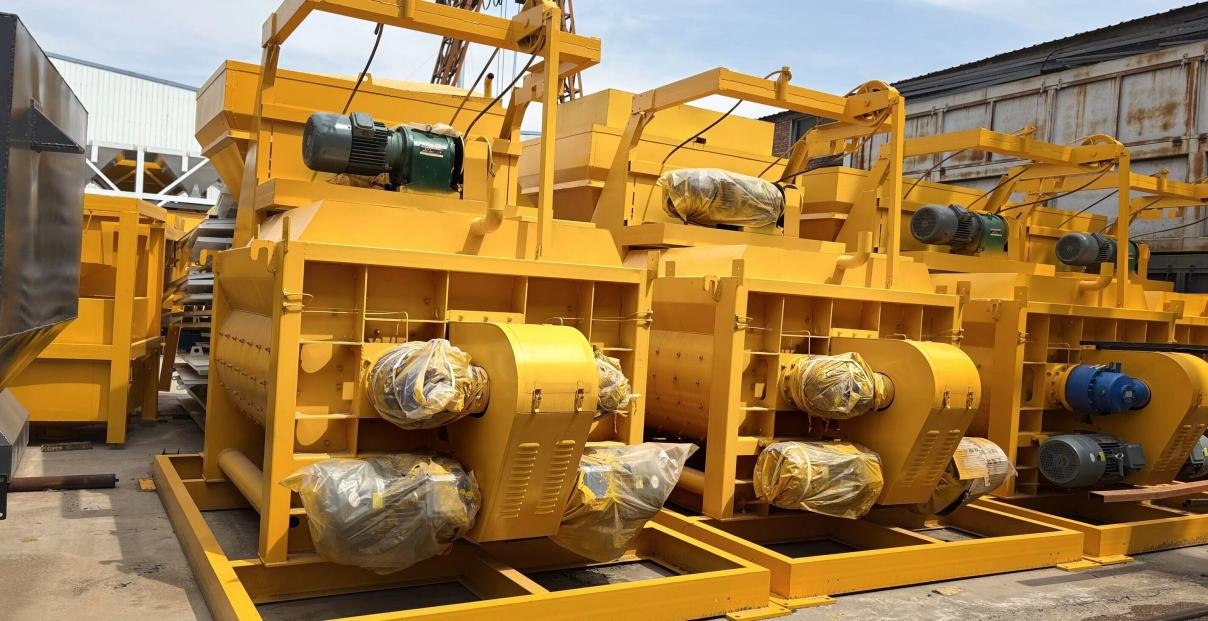
Display Diagram of Main Mixer, Zhengzhou Chuangsheng Machinery